When someone shifts into a smaller form than usual, their extra mass is shunted into a random area In “Z-Space,” the same alternate dimension that the yeerks and andelites use to travel faster than light
I don’t know if it ever happened in series, but one of the dangers the kids were warned about was that one day, a ship may randomly pass through the section of Z-space where all their extra mass is being held and destroy it, and if that happens and they’ll die immediately if they try and shift back bc it’ll be refilling their body with empty space
Why was animorphs like that
Yeah I remember when they turned intoooo mosquitos they accidentally zooped into z space and were floating in white nothingness but got saved by an andalite ship. I rememebr KA Applegate like won some science fiction award for that concept . I remembered it all my life because it scared the shit out of me
Her tuition so damn high she can wear whatever tf she wants
Spite goals
There’s a better thing to her story. She CONTINUED her thesis in her underwear and afterward her professor said “what would your mother think wearing those kinds of clothes”
And she responded “my mother’s a feminist also a gender and sexuality studies professor. She’s fine with my shorts”
i think the best part is that a majority of the class also stripped with her in solidarity
Just to give a little more perspective after reading the story:
The sequence of events is a little jumbled in the telling above. The actual chastising from the teacher came days before the woman’s thesis, during a practice run of her presentation. This was not a spur-of-the-moment thing where she just whipped off her clothes for the sake of being angry. Chai took the time to think things through before deciding this was the way she wanted to protest. She used critical thinking and level-headedness to decide instead of becoming volatile and aggressive, she would choose non-violent protest.
I just don’t like the way the story’s being told by others because it makes her come across as “overly-emotional” and “erratic” (as women often do in the media, because it’s easier to attribute extreme action to “hysteria”), whereas in actual news reports, she had time to think about her decision and choose the best way to handle what happened to her.
Mostly reblogging for the last comment. When you give tidbits of info on a story it really makes people’s imagination run wild. The lack of communication definitely warranted an explanation and I’m glad @lalaofrp took the time to explain and offer sources.
Gaelic hasnt been lost. It’s never died or been brought back. There’s an unbroken line of native speakers going back to the beginning of the language. That doesn’t seem like a ‘lost’ language to me. Furthermore I’m not sure what ‘artificial life-support’ means in this context. Gaelic is given funding for schools because there’s still native speakers of the language. It’s no more artificial than money being given to schools for English language lessons.
If anything is ‘artificial’ its the imposition of a foreign language
(English) into a Gaelic majority zone and native speakers having to
fight for decades to be able to be taught in their own language. Native speakers being forced to learn English to exist within their own regions because a central government would not allow services to be given in a people’s own language.
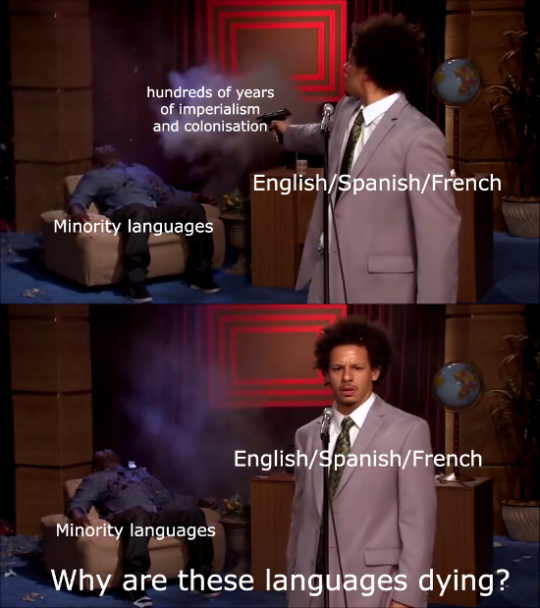
But then the clock only goes back so far with people who wish that minority languages would just die. There’s nothing artificial about shooting someone but suddenly it becomes an ‘artificial’ act to maybe phone an ambulance?
“There’s nothing artificial about shooting someone but suddenly it becomes an ‘artificial’ act to maybe phone an ambulance?” — THIS RIGHT HERE
Also just gonna point out here:
In the UK, the languages Gaelige, Gaelic, Cymraeg and Kernewek (that’s Irish, Scottish, Welsh and Cornish respectively) didn’t just “die out.” There was a concerted effort by the English to kill them off.
For example, in Wales, if a child was heard speaking Welsh in a classroom, they’d be given a “Welsh Not”, a wooden plaque engraved with “WN” to hang around their neck. They’d pass it onto the next child heard speaking Welsh, and whoever had the Welsh Not at the end of the day was punished – usually with a beating.
Kernewek was revived after a long hard struggle by the Cornish folk, and is now being taught again, but a lot about it has been lost because everyone who grew up speaking it has died.
And languages are never revived “just because.” The language of a place can offer so much insight into its history, so if you’re content to let a language die then you’re content to let history die.
People talk about “dead” languages as if they dwindle away gradually, naturally coming to an end and evolving into something else, but that’s rarely the case. Languages like Cymraeg and Gaelige and especially Kernewek didn’t have the chance to die with dignity, they were literally beaten out of my parents and grandparents.
Is it any wonder every other country hate the English? We invade their country, steal their history, claim pieces of their history as ours or flat out re-write it, and kill every part of their culture that we can.
It’s a miracle that any of the Celtic languages survived, so even if you don’t see the point in keeping them alive, the actual natives of each country we’ve fucked over are clinging onto what heritage they have left through the only thing they can: their language.
Hey OP, póg mo thóin!
*snerk* xD
I would like to point all of these “just let it die” assholes directly at Hebrew.
The language was effectively dead. It had been murdered and forced-assimilated away.
But there was this dude named Ben Yehuda.
And he said “no.”
“The language of my people for four thousand years or more,” he said, “should not stop existing because of a bunch of assholes.” (Okay, this is a dramatic retelling. He probably didn’t actually say assholes.)
So he started an official movement to recreate Hebrew as closely as possible to how it had been spoken about a thousand years prior.
Today, ancient Hebrew is spoken by millions of Jews around the world weekly in our prayers and Torah readings, and modern Hebrew is the official language of eight and a half million people–many of them having been born speaking it as a first language. Many people in the first group also speak at least some modern Hebrew–and it’s possible you do, too! A lot of loan words from Hebrew and Yiddish have made their way into English (like klutz, mensch, and kibitz).
That’s hardly “on life support.” Hebrew is growing, living, and thriving because of the Enlightenment efforts of the 1800s. The same COULD be done for languages like Welsh, Navajo, and Basque if the larger powers that be said “this is important” rather than forcing a giant bastion of culture–the language in which a people lived, loved, thought, told stories, and explained their world–to die.
there is a distinct difference between language that has died because it stopped meeting the needs of the people using it and language that has been deliberately killed by oppressors
I remember reading a linguist’s thoughts on this a while back. They noted that languages are not only an important cultural heritage, but also an important historical artifact that offers a look into the unique perspective of a culture. The things that we name and how we name them reflect our values and priorities. For example, Inuktitut is said to have several different words for snow that categorize them by various metrics. This reflects a need for communication regarding what the snow was like, which naturally would be important to a people who deal with snow on a near constant basis. There are nine different ways to say “you’re welcome” in Native Hawaiian, each responding to a different level of gratitude. You don’t respond the same way to “thanks for giving me a donut” as you do to “thanks for saving my life.” This reflects a culture of accountability and honor.
The study and preservation of indigenous languages worldwide is vital to the enrichment of our global culture. You don’t have to be fluent in multiple languages to be able to understand the perspective that is offered by nurturing this tradition. Our ability to communicate is one of our greatest gifts – what a waste it would be to throw that away simply because providing institutions of cultural heritage is too inconvenient.
My step sister is among the first generations of non-Cree as primary language speakers from her Nation.
A hundred years of residential schools, four hundred years of genocide, and Cree is not a dead language. It survives and it will thrive, as long as our society places value on it.
I can go most places in my city and hear Indigenous languages, because they live. They aren’t dead.
Also, I wonder if OP feels this way about Latin, which is used, for example, in naming scientific specimens. Why use a dead language for that?
Created this queer little comic after two weeks of learning Color as Storytelling! The superheroine’s plan to save her shepherdess girlfriend does not go as planned …

 Dama Cherepaha