4chan boards like /ck/, /lit/, and shit are so funny because they take a culture that’s as abrasive and as edgy as possible and put it inside a traditionally calm normal hobby so you get language like “whoever doesn’t butter your yams go fuck yourself you filthy piece of shit”
The last time I was on /ck/ someone said he liked to put soy sauce on his spaghetti and the first reply told him he’d beat him to death if he ever said that again.
I haven’t been to /ck/ for ages and I’m glad I went back
Ladies, you know how we can’t fit more than a single tube of lip balm into the pockets of most of our clothing for reasons that remain unsatisfactory to us all?
Tonight I learned that, back in the days when women’s pockets were separate articles of clothing worn tied around the waist under the skirt, one woman was convicted of theft for PUTTING A WHOLE DUCK INTO EACH POCKET AND WALKING AWAY WITH THEM.
My jeans won’t even hold my keys comfortably. We have been robbed of the joy of surreptitiously stealing large and ungainly objects including waterfowl, dammit!
I found my note on that case!
Court case from 1777, Worcestershire. A woman “of bad character,” Jane Griffiths, was brought to trial for stealing two ducks from a man named Thomas Wainwright. She tried to steal them by stuffing them in her pockets and taking off running. (as quoted in Barbara Burman, Pockets of History).
Ladies. Pockets used to be a whole big bag under your outer skirt, like sometimes two of them, and you always had them on your person or under your pillow. Unless you lost yours, devastating if you’d had personal stuff in there See English nursery rhyme:
Lucy Locket lost her pocket, Kitty Fisher found it,
not a penny was within it, but a ribbon round it.
So men were threatened by the fact that a woman could have concealed items on her at any time, in her pocket under her layered floofly skirt. She could hide a full change of clothes and money in there if she wanted to, for example, leave a bad marriage… so in the early 1800s when skirts went narrower, probably intentionally to stop the whole stashing stuff in your skirt trend, men designed the reticule, ie the purse, a charming fashion accessory which is easier to just take off a woman to confiscate her ability to carry personal property. Besides, a reticule is kept small so as to be feminine. And unable to hide anything too valuable. And since then women’s clothing has not had big pockets. “You have purses, girls, you dont need to carry anything personal on you like you have secrets or property, now let me look through that purse.”
Seen in the window at Gulf of Maine Books in Brunswick, Maine.
Photo: Bill Roorbach
Except America wasn’t an endless expanse of forest with no certain borders. At least not while human beings inhabited it. The idea that native peoples did not cultivate or shape our land and that we had no borders is white propaganda meant to dehumanize and de-legitimize native peoples.
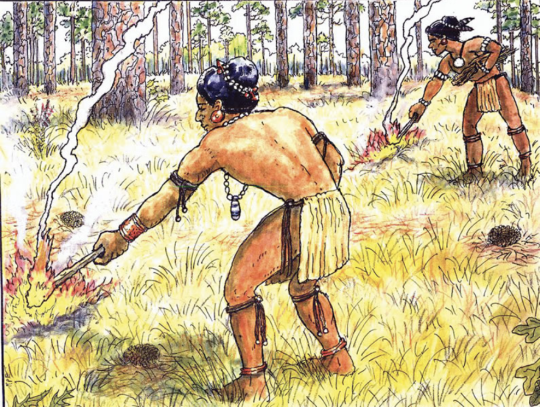
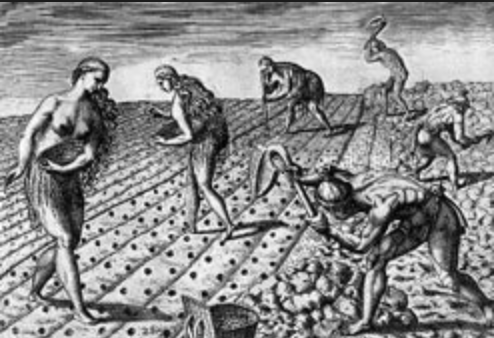
This illustration here show Apalachee people using slash and burn methods for agriculture. Fires were set regularly to intention burn down forests and plains. Why would we do this? Well because an unregulated forest isn’t that great for people, actually. We set fires to destroy new forest growth and undergrowth, and to remove trees, allowing for easier game hunting, nutrient enriched soil, and better growth rates for crops and herbs we used in food and medicine.
Pre-Colonial New England, where my tribe the Abenaki are from, looked more like an extensive meadow or savannah with trees growing in pockets and groves. Enough woodland to support birds, deer, and moose, but not too much to make hunting difficult. We carefully shaped the land around us to suit our needs as a thriving and successful people. Slash and burn agriculture was practiced virtually everywhere in the new world, from the pacific coast to chesapeake bay, from panama to quebec. It was a highly successful way of revitalizing the land and promoting crop growth, as well as preventing massive forest fires that thrive in unregulated forests. Berries were the major source of fruit for my tribe, and we needed to burn the undergrowth so they could grow.
That changed when white people invaded, and brought with them disease. In my tribe, up to 9 in 10 people died. 90% of our people perished not from violence starvation, but from disease. Entire villages would be decimated, struck down by small pox. Suddenly, we couldn’t care for the land anymore. There weren’t enough of us to maintain a vast, carefully structured ecological system like we had for thousands of years. We didn’t have the numbers, or strength. So the trees grew back and unregulated. We couldn’t set fires anymore, and we couldn’t cultivate the land. And white people would make certain we never could again. Timber, after all, was the most important export from New England.
Endless trees and untamed wilderness is a nice fantasy. But it’s a very white fantasy, one that erases the history of my people and of my land. One that paints native peoples are merely parasites leeching off the land, not masters of the earth who new the right balance of hunting and agriculture. It robs us of our agency as people, and takes our accomplishments from us. Moreover, it implies that only white people ever discovered the power to shape the world around them, and that mere brown people can’t possibly have had anything to do with changing our environment.
Don’t bring back untamed wilderness. Bring back my fire setters, my tree sappers, my farmers and my fishers. Bring back my people who were here first.







 Dama Cherepaha